
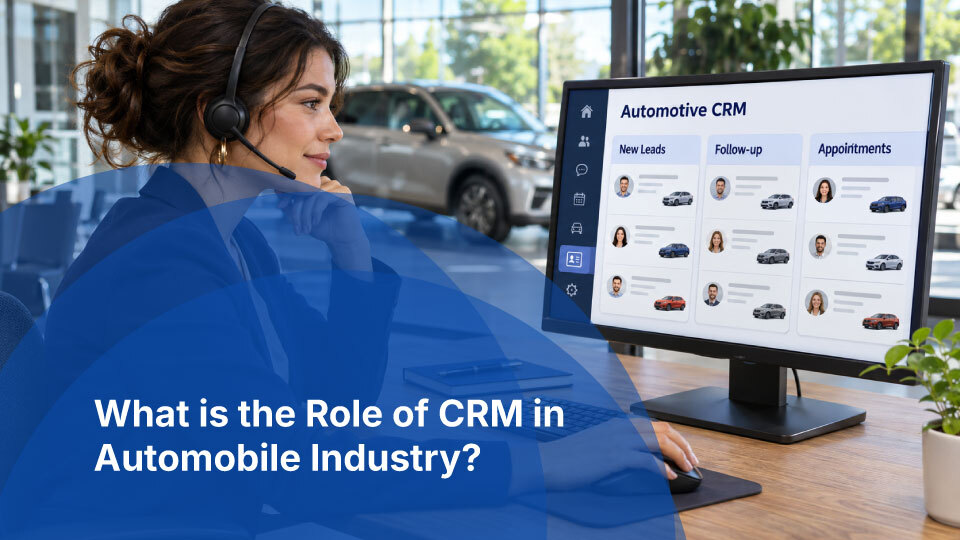
When we mention customer relationship management (CRM) in automotive, it refers to a better ecosystem for managing customers at dealerships. And if we tell how beneficial it is, then we must turn back to 2025 research that says,
“CRM software drives an average 29% increase in sales, a 34% boost in sales productivity, and a 42% improvement in sales forecast accuracy.”
That’s the benefit of using a dedicated CRM for your business to actually grow your revenue and win your customers’ trust. However, the question stays the same: what’s the role of CRM software in BDC at dealerships?
In 2026, things are moving really fast. With technological advancements, customers expect more than just instant responses when making a decision to purchase an asset. That’s why we’ve made this trends guide for you to define what a CRM does for dealerships.
What is Customer Relationship Management (CRM)?
Customer relationship management (CRM) is specialized software that helps businesses manage leads, customer information, and interactions throughout the customer lifecycle.
For dealerships, a dedicated CRM manages customer relationships from the first inquiry to vehicle purchases, test-drive appointments, and future service interactions.
Unlike general-purpose CRM systems, automotive CRM software focuses on dealership-specific requirements, including:
- Capturing leads from websites, phone calls, social media, and third-party marketplaces.
- Organizing customer information and communication history.
- Tracking sales opportunities and lead status.
- Assigning leads to sales representatives and BDC teams.
- Scheduling follow-ups, test drives, and appointments.
- Monitoring sales performance and customer engagement.
The goal is to ensure every customer receives timely attention and every sales opportunity has a clear next step. At first, dealerships may also get confused between CRM and DMS. Although both systems support dealership operations, they serve different purposes.
CRM vs DMS: What’s the Difference?
Dealerships often use CRM and Dealer Management Software (DMS) together, but both serve different purposes.
CRM handles the customer-facing side of dealership operations, while DMS manages various administrative and operational activities.
Here is a comparison showing how they differ:
| Area | CRM | Dealer Management Software |
|---|---|---|
| Primary Focus | Customer relationships and sales | Complete dealership operations |
| Lead Management | Tracks leads and opportunities | May include sales pipeline tools |
| Customer Records | Manages customer information | Includes or integrates customer data |
| Inventory Management | Usually needs integration | Central inventory management |
| Sales Activities | Handles follow-ups and tasks | Connects sales with other workflows |
| Machine Details | Limited or externally managed | Stores specifications and images |
| Online Listings | Requires external integrations | Connects inventory to websites and marketplaces |
| Pricing & Availability | Relies on connected systems | Links pricing to inventory records |
| Reporting | Tracks leads and sales performance | Covers sales, inventory, and operations |
A CRM helps dealerships manage customer relationships and sales opportunities, while a DMS connects broader dealership operations. Integrating both can give dealership teams better visibility across their workflows.
The Role of CRM for the Automotive Industry in 2026
The role of CRM software for a dealership isn’t just capturing leads; it’s a multichannel lead management platform that helps them manage leads, numbers, and actions, instead of juggling spreadsheets. Whatever, here are some of the most important roles of a CRM for a dealership in 2026:
1. Centralized Lead Management
Advanced dealerships receive customer inquiries from multiple channels, including website forms, phone calls, social media, and advertising campaigns. When it comes to managing these inquiries across different channels, doing so will be stressful and time-consuming, and the leads may go cold.
Sales representatives may miss messages, duplicate customer records, or forget to follow up with interested buyers. An automotive CRM brings these inquiries into a centralized system where dealership teams can:
- Capture leads from multiple communication channels.
- Organize customer information in one place.
- Assign inquiries to the appropriate representatives.
- Track lead status and sales opportunities.
- Monitor interactions and follow-up activities.
This centralized approach gives managers better visibility into the sales pipeline and helps prevent potential customers from slipping through the cracks.
2. Faster Customer Responses and Engagement
Response time can significantly influence a customer’s purchasing decision. When someone submits a vehicle inquiry, they may contact several dealerships simultaneously. If your dealership takes hours to respond, another competitor might already have scheduled a test drive.
CRM systems help dealerships improve response times through automated notifications, communication workflows, and follow-up reminders. More advanced platforms also use AI-powered voice and chat agents to respond to inquiries outside regular business hours.
For example, an AI-powered lead response system can:
- Acknowledge new inquiries immediately.
- Answer common customer questions.
- Qualify potential buyers.
- Route conversations to the appropriate sales representative.
- Schedule appointments when supported by calendar integrations.
The objective is simple: make sure customers receive attention when they are most interested in purchasing a vehicle.
3. Automated Follow-Ups and Lead Nurturing
Not every customer purchases a vehicle immediately after contacting a dealership. Some are comparing prices, exploring financing options, or waiting for the right vehicle to become available. Without a structured follow-up process, these opportunities can easily be forgotten.
Automotive CRM software helps dealerships establish consistent communication through automated reminders, scheduled messages, and follow-up workflows.
For instance:
- A customer requesting vehicle pricing receives a timely follow-up.
- A prospect who misses a test drive receives an appointment reminder.
- An undecided buyer receives relevant information about available vehicles.
- A previous customer receives communication about future service requirements.
These activities help dealerships maintain relationships without relying entirely on manual follow-ups.
However, automation should complement human communication rather than replace it. Sales representatives should remain involved when customers need detailed answers, negotiations, or personalized assistance.
4. Better BDC and Sales Team Coordination
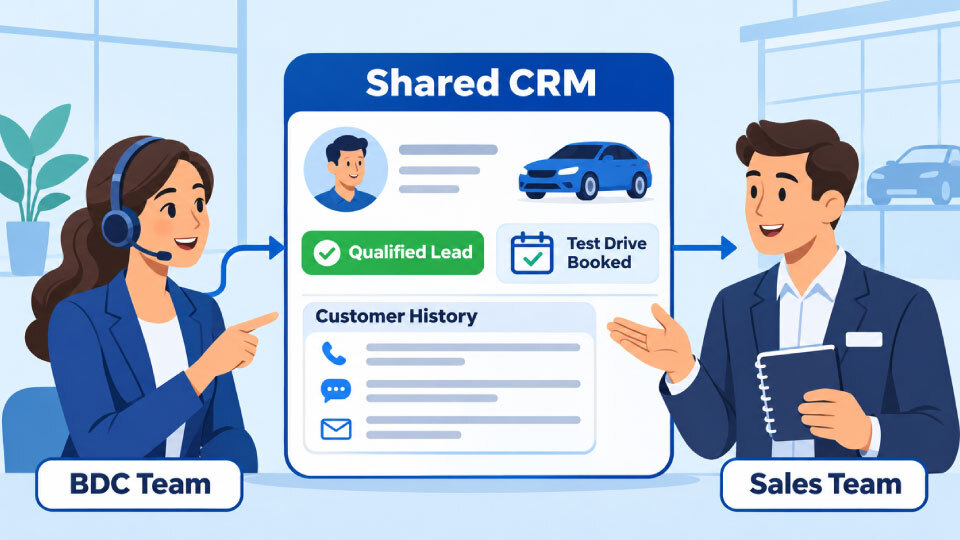
A dealership’s Business Development Center (BDC) plays an important role in handling incoming inquiries, qualifying prospects, scheduling appointments, and following up with potential customers.
However, communication gaps between BDC representatives and sales teams can create missed opportunities. A CRM provides a shared environment where both teams can access relevant customer information and track ongoing activities.
For example, when a BDC representative qualifies a lead and schedules a test drive, the assigned sales representative can access the customer’s information and conversation history before the appointment.
This improves:
- Lead ownership and assignment.
- Communication between BDC and sales teams.
- Appointment scheduling and tracking.
- Follow-up accountability.
- Visibility into team performance.
A structured CRM workflow also helps dealerships identify operational problems, including delayed responses and inconsistent follow-ups, before they affect sales performance.
5. Customer Data Management and Personalization
Every customer has different preferences, purchasing requirements, and communication expectations.
Some buyers are interested in new vehicles, while others are looking for used inventory, financing options, or specific vehicle features. An automotive CRM organizes customer information so dealership representatives can understand individual requirements and deliver more relevant communication.
Depending on the system, customer records may include:
- Contact information and communication preferences.
- Vehicle interests and purchasing requirements.
- Previous inquiries and interactions.
- Appointment and follow-up history.
- Purchase and service-related information.
With this information, sales representatives can personalize their conversations instead of approaching every customer with the same generic sales message.
For dealerships, better customer data management also creates opportunities for repeat purchases, service retention, and long-term customer relationships.
How to Choose the Best CRM Platform for a Dealership
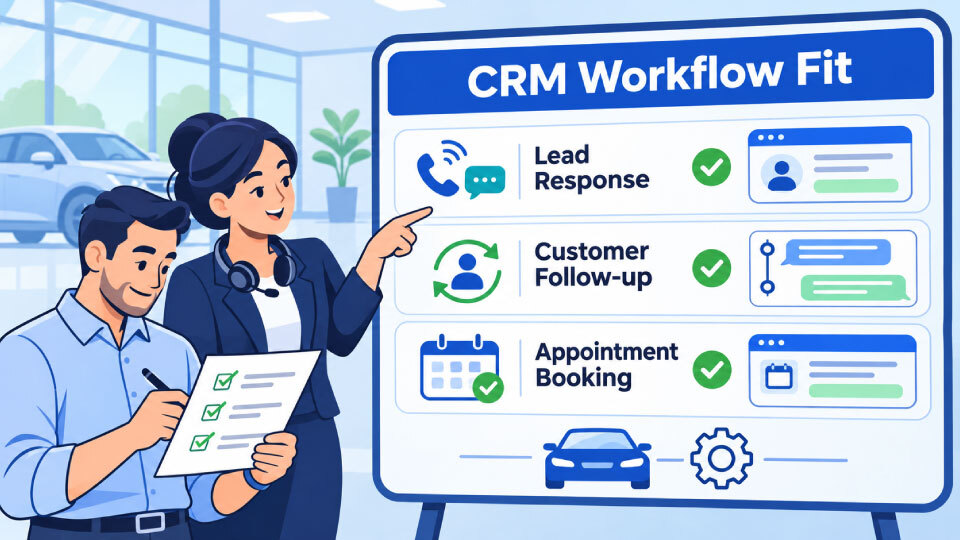
Every dealership wants to strengthen its market position, build customer trust, and generate more revenue. However, achieving these goals requires the right technology and a structured approach to customer management.
Choosing an automotive CRM shouldn’t be based on the number of features a platform advertises. Instead, dealerships should evaluate how well the system fits their existing workflows and business requirements.
Here are four important factors to consider.
1. Lead Capture and Multichannel Integration
Start by evaluating how the CRM captures customer inquiries. A dealership may receive leads through its website, phone calls, social media, advertising campaigns, and automotive marketplaces.
Your CRM should support the channels your dealership actually uses and provide a centralized view of incoming inquiries.
Check whether the platform supports:
- Website form integration.
- Phone and SMS communication.
- Social media lead capture.
- Third-party lead sources.
- CRM and DMS integrations where required.
The more effectively your system connects these channels, the easier it becomes to manage customer interactions.
2. Automation and AI Capabilities
Manual follow-ups consume valuable time and can lead to inconsistent communication. Look for a CRM or connected lead management platform that supports automated workflows, response notifications, lead routing, and appointment scheduling.
AI-powered capabilities can provide additional value by handling initial customer conversations, qualifying inquiries, and responding outside business hours. However, automation should be configurable and allow human representatives to take over when a conversation requires personal attention.
3. Reporting and Performance Visibility
A CRM should provide more than a database of customer records. Evaluate whether it gives managers useful insights into lead activity, response times, appointment performance, and sales pipeline progress.
A reporting dashboard should help you answer questions such as:
- How many leads are coming into the dealership?
- Which channels generate the most inquiries?
- How quickly are representatives responding?
- How many leads are converting into appointments?
- Which follow-ups are overdue?
- Where are potential sales opportunities being lost?
These insights help dealerships make improvements based on actual performance rather than assumptions.
4. Scalability, Usability, and Integration
The best CRM should support your dealership as it grows. A system that works for one location should ideally accommodate additional teams, locations, and workflows as business requirements change.
Before choosing a platform, consider:
- Whether the interface is easy for employees to use.
- Whether it integrates with your existing dealership systems.
- Whether it supports multiple users and locations.
- Whether training and technical support are available.
- Whether its pricing aligns with your dealership’s requirements.
A feature-rich CRM isn’t necessarily the best choice if employees struggle to use it. Prioritize a platform that your team can adopt and use consistently.
Why Choose OmnePulse for Your Dealership as a Dedicated CRM
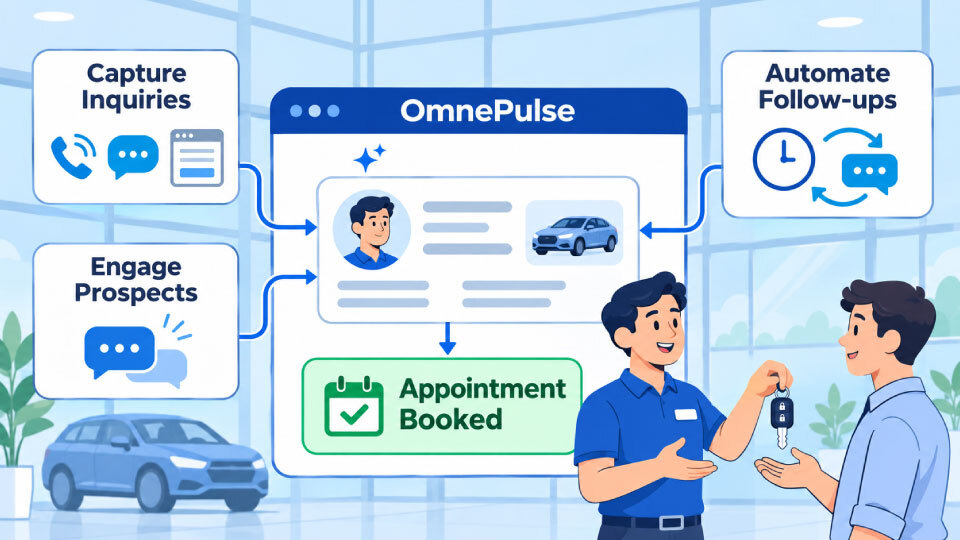
Choosing the right CRM is important, but dealerships also need a reliable process for responding to inquiries and converting potential buyers into appointments.
That’s where OmnePulse comes in.
OmnePulse is an AI-powered lead response and management platform designed to help businesses capture inquiries, engage prospects, automate follow-ups, and improve appointment generation.
Rather than requiring dealerships to abandon their existing CRM, OmnePulse can integrate with existing customer management systems and help strengthen the lead engagement process.
Here is how it supports dealership operations:
1. AI-Powered Lead Response
OmnePulse helps dealerships respond to digital inquiries within 60 seconds through human-like AI voice calls and communication workflows, including after business hours. This allows dealerships to engage potential buyers while their interest is still high.
2. Centralized Lead Capture and Routing
The platform supports lead capture across multiple channels, including website forms, phone systems, and social media. It can qualify incoming inquiries, prioritize prospects, and route them to the appropriate team members based on configured workflows.
3. Automated Follow-Ups
Instead of depending entirely on representatives to remember every follow-up, dealerships can use automated sequences to maintain consistent communication with potential buyers. The system continues nurturing leads until they visit, book an appointment, or move further along the purchasing journey.
4. AI-Powered Appointment Booking
OmnePulse can use AI voice conversations to qualify prospects and schedule appointments, including test drives, through calendar integrations. This reduces manual coordination and helps sales teams focus on customers who are ready for the next step.
5. CRM Integration and Reporting
OmnePulse connects with existing CRM and business systems to synchronize customer information and communication activities. Its reporting capabilities also help businesses monitor lead activity, communication performance, and customer engagement.
Your dealership doesn’t necessarily need to replace its existing CRM to improve lead management. It needs a connected process that ensures every inquiry receives timely attention, every opportunity has a clear next step, and your team can focus on converting interested buyers.
Explore OmnePulse to see how AI-powered lead response and automation can support your dealership’s sales process.